Frigidaire Dishwasher Handle Replacement vs. New Unit: A Commercial Buyer's Honest Comparison
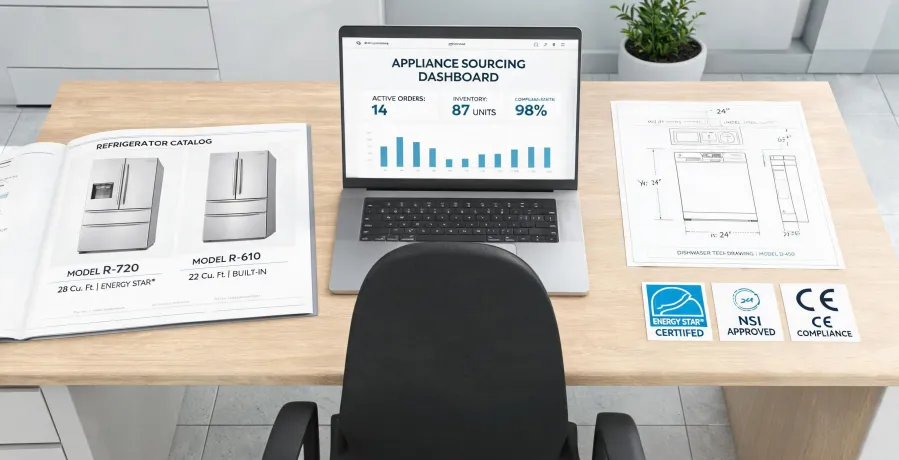
I'm not a repair tech. I'm the office administrator who signs off on repair tickets for a 200-person company with three locations. I manage all appliance ordering—roughly $120,000 a year across about a dozen vendors—and I report to both operations and finance. When a Frigidaire dishwasher handle breaks in the breakroom, I'm the one deciding whether to approve a replacement part or a whole new unit.
This is a comparison between two ways of thinking: repair-first versus replace-first. I'll use the Frigidaire dishwasher handle replacement as the main example, but the same framework applies to ovens, washers, and a lot of other commercial appliances.
The Real Comparison Isn't Part vs. Appliance
Here's the thing that took me a while to learn: the handle isn't the decision. The dishwasher is. A Frigidaire dishwasher handle replacement is one of those jobs that looks simple on paper. But if the unit has had three service calls in the last year, the handle is just the thing you happened to notice.
If the handle is the only thing wrong with the unit, fix it. If it's the third thing to go wrong in a year, replace the unit.
I compare both approaches on four dimensions: cost, downtime, reliability, and the surrounding room. The last one is where the smart stuff comes in.
Dimension 1: Upfront Cost vs. Total Cost
Let's start with the obvious numbers. A Frigidaire dishwasher handle replacement assembly costs roughly $45 to $130, depending on finish and trim. I looked this up on Frigidaire's official parts site in January 2025, and those prices check out against the major online appliance part retailers. If your maintenance person installs it, labor is basically free. Call a service company, and you're at $200 to $300 with the service call.
A new commercial dishwasher from Frigidaire runs somewhere around $700 to $1,600, plus installation and haul-away. This pricing was accurate as of Q1 2025. The market changes, so verify current quotes before you tell finance.
But here's where I'll be contrarian: the hard cost isn't the number that matters. The total cost is. When I say total cost, I do not mean just the invoice. I mean the downtime, the risk of flooding, and the hours your maintenance person spends ordering the wrong trim kit. Last year, I approved a handle replacement on a dishwasher that had a weak door latch too. I knew I should check the latch, but I thought, 'what are the odds?' Well, the odds caught up. Three weeks later the door popped mid-cycle and flooded a corner of the breakroom. That repair cost us $900 in floor damage. The handle replacement ended up being the most expensive cheap fix I've ever approved.
Dimension 2: Downtime Is a Cost, Even If It's Not on the Invoice
Repair-first is faster only if you have the part. A Frigidaire dishwasher handle replacement is a 20-minute install once the part is in front of you. But shipping can take two to ten days, and if the part is backordered, that timer resets. In a commercial breakroom, that means employees stacking dishes in the sink and doing that little sigh every time they walk by.
Replace-first is slower upfront. A new unit usually takes three to fourteen days to arrive, plus an install appointment. But when it's done, the clock resets. You know the full history of the unit, and the warranty starts fresh.
There's no metric for employee sighing, but I can tell you the indirect cost is real. In 2022, I had two hours to decide before a vendor's end-of-month sale. Normally I'd get three quotes, but there was no time. I went with a dealer I trusted, and the unit arrived in four days. Then it sat in storage for eleven days because the installer couldn't fit us in. In hindsight, I should have verified the install timeline before ordering. But with the sale deadline, I made the call with incomplete information.
Dimension 3: Reliability, Parts, and Reviews
This is the dimension where a lot of buyers get stuck. The only thing worse than replacing a dishwasher too early is replacing it too late. For me, the tiebreaker is parts availability and review patterns.
Frigidaire is a legacy brand with a genuinely organized parts network. That matters more to me than any single review. I don't have hard data on industry-wide failure rates, but based on the 60 to 80 appliance orders I process every year, my sense is that parts availability is what keeps repair-first alive.
Now, about the reviews. The Frigidaire microwave reviews I've tracked for office breakrooms are mixed, and I'm okay with saying that. Some models are workhorses. Some have interior paint that chips if someone scrubs too hard. The trick is to sort reviews by date, not by star rating, and look for repeated patterns. If the same component fails after fourteen months in multiple reviews, that's a maintenance item you'll own. But if a review says the unit wouldn't power on out of the box, that's quality control, not a design flaw.
When I'm comparing repair vs. replacement, I use the same logic. A part that's annoying to replace is a maintenance item. A part that fails repeatedly is a red flag. That's why I don't buy an appliance just because it has a 4.5-star average. I buy it because I can still get a door handle for it in five years.
Dimension 4: Upgrade the Room, Not Just the Appliance
What was best practice in 2020 may not apply in 2025. The fundamentals haven't changed—you still want cold fridges and working dishwashers—but the execution has transformed. While you're waiting on the dishwasher decision, look at the rest of the breakroom. Sometimes the smarter upgrade isn't the appliance; it's the controls around it.
Feit Smart Plug Setup
Honestly, the Feit smart plug setup is one of the easiest wins in building management. Plug it in, download the Feit Electric app, put the plug in pairing mode, and connect to your Wi-Fi. The catch is the 2.4 GHz thing. Most office routers broadcast both 5 GHz and 2.4 GHz under the same name, and the plug won't connect if it can't see the right band. Fix that with a separate 2.4 GHz guest network. Took me fifteen minutes to do three plugs, and now our coffee maker doesn't run all weekend.
Best Room Mapping Robot Vacuum
If you're looking for the best room mapping robot vacuum for an office, compare it against the $99 random-bounce kind. A random-bounce vacuum will eventually hit every spot, but it'll also eat cables and wedge itself under the vending machine. A mapping robot uses LIDAR or vSLAM to build a floor plan, remembers no-go zones, and actually finishes a room before its battery dies. Is the mapping version worth the extra $200? For one open office, not always. For three locations with conference rooms and a breakroom with a step down, yes. The mapping feature is the only reason ours doesn't live behind a filing cabinet.
How to Oil Ceiling Fan
The same repair-first logic applies to ceiling fans. If you're wondering how to oil ceiling fan, start by checking the motor housing for oil plugs. If there are none, stop—it's sealed. If there are, turn off the power, remove the plug, add two to three drops of non-detergent 30-weight oil, run the fan for a minute, and wipe away any excess. That fixes a lot of humming that people want to replace. But if the wobble comes from a bent mount, oiling won't help. That's a replacement decision.
So Which Do You Choose?
Here's my rule of thumb, not a universal answer.
- Choose repair if the unit is less than 8 years old, the failed part is routine, and the whole unit hasn't needed a service call in the past 12 months.
- Choose replacement if the unit is older than 10 years, the part is backordered, or you're seeing multiple failures appear at the same time.
- Upgrade the surrounding infrastructure while you're at it—smart plugs, mapping vacuums, and a ceiling fan that doesn't sound like a helicopter are cheaper than you think.
No single answer works for every building. But if you compare the right dimensions without pretending the invoice tells the whole story, you'll make fewer expensive mistakes than I did. That's basically it.

Greta Lindholm
Greta Lindholm is a household refrigeration analyst covering French-door, side-by-side, top- and bottom-mount refrigerators, mini fridges, beverage coolers, chest freezers, and upright freezers. She applies IEC 62552 and IEC 60335-2-24 while comparing energy consumption, usable volume, pull-down time, compartment temperature stability, freezing capacity, noise, door-seal leakage, refrigerant charge, and ambient-temperature performance. Her guides help importers, distributors, private-label teams, and appliance engineers select platforms around climate class, storage mix, efficiency labels, cabinet dimensions, service access, shipping density, and warranty exposure.