Frigidaire Dishwasher Leaking? The Real Problem Isn't the Dishwasher
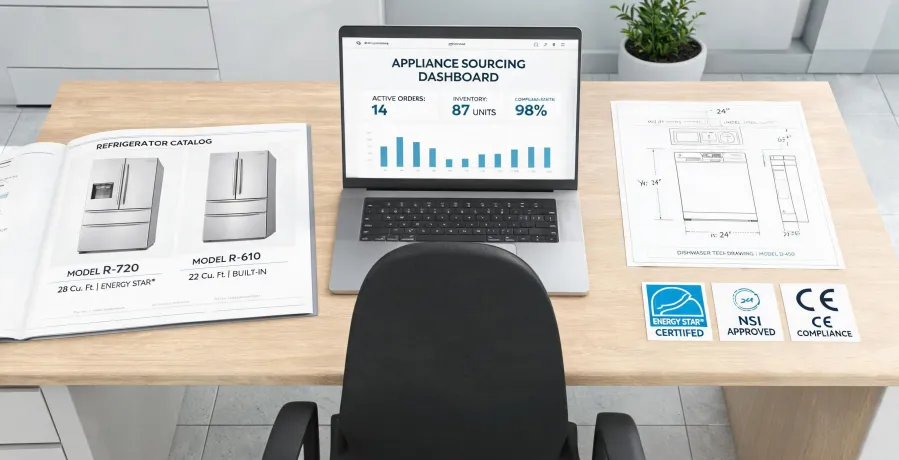
I'm a quality and brand compliance manager at a commercial appliance distributor. I review every unit before it reaches customers—roughly 400 units a year. I've rejected about 11% of first deliveries in 2024, and most of those weren't broken. They were wrong: wrong dimensions, missing install kits, incompatible clearances.
Earlier this year, I stood in a kitchen that had just come out of a $180,000 renovation. Under the Frigidaire dishwasher, there was a small lake. The contractor said, 'Frigidaire dishwasher leaking. Warranty issue, right?' It wasn't. Frigidaire warranty repair became the conversation, but the leak had nothing to do with the machine and everything to do with the purchase order.
Let me start with the lesson I had to learn the hard way. I used to think spec sheets were the source of truth—or rather, I wanted them to be. Three expensive mismatch claims later, I realized the only reliable source of truth is the as-built condition on the job site.
The Surface Problem Is Rarely the Problem
Anyone searching 'Frigidaire dishwasher leaking' is looking for a culprit: door gasket, pump, drain hose, water inlet valve. Those are legitimate possibilities. But in the callbacks I've reviewed, the most common cause was installation. The unit wasn't level. The drain line wasn't routed into a high loop. The supply line was cross-threaded. None of that appears on the spec sheet.
How Deep Is a Counter Depth Fridge? The Answer Is Not a Number
Someone will ask, 'how deep is a counter depth fridge?' and expect one number. As of January 2025, the honest answer is: it depends on the manufacturer. There is no single engineering standard that defines counter-depth; AHAM's HRF-1 covers refrigerator capacity, not cabinet depth. The published depth can exclude handles, include handles, or ignore the clearance gap behind the unit.
I have seen a refrigerator with a published depth of 29.5 inches end up 33 inches from the wall because the wall outlet cap, water line, and baseboard added 3.5 inches. The spec sheet didn't lie. It was just incomplete.
Why You Now Have a Frigidaire Warranty Repair Conversation Instead of a Working Kitchen
A warranty is a repair promise, not a performance guarantee. It does not cover installation errors, water-quality damage, or poor service practice. In many cases, labor coverage is limited, and commercial-use exclusions are in the fine print. When someone searches for Frigidaire warranty repair after a leak, the leak is already two problems deep: the physical leak and the coverage gap.
Let me put a number on it. I compared two quotes for a similar refrigerator: one was $500 lower, but without an install kit and extended labor coverage. After the install kit, the callback, and the 'warranty repair' that didn't cover labor, the lower quote ended up costing more. To be fair, warranty repairs themselves are usually free. The downtime is not. The service appointment wait is not. The second trip is not.
The deeper issue is that we buy products instead of installations. The appliance is a box with specs. The installation is a system with clearances, connections, airflow, and service access. Buyers who compare only the box end up with a leaking dishwasher, a counter-depth fridge that sticks out, and a transfer of money from their maintenance budget to their emergency repair budget.
The Cost of Treating Specs Like Shopping List Items
This is not an abstract quality lecture. A leaking dishwasher in an apartment building can damage a vinyl floor, pull a unit out of service, and generate a resident complaint. The repair might be $150, but the claim, the cleaning, and the lost rental night can reach $3,500. A fridge that protrudes 4 inches into a corridor feels wrong every single day. A hot kitchen with a weak 30 inch pedestal fan becomes a comfort complaint and then a staffing issue.
And small appliances follow the same pattern. If you are specifying a cold press juicer Breville model for a juice bar, the brand name is not the warranty, and the price is not the operating cost. I have seen operations buy a beautiful juicer and then discover that cleaning takes twenty minutes, replacement parts are a special order, and throughput is too low for lunch service. The appliance ends up occupying counter space instead of generating revenue.
The blind spot is easy to understand. The 'just get the 30 inch pedestal fan' thinking comes from an era when we bought equipment by size and name. Today, a fan needs a CFM rating, a motor duty rating, and a UL listing. A juicer needs a service plan. A refrigerator needs an as-built measurement.
Last year I compared two mid-size commercial kitchen openings. Same budget, same appliance list. One team set aside $700 for installation verification, clearance checks, and parts. The other chose the lowest bids. The first team had one minor callback. The second had four, including the leaking dishwasher. I'm not 100% sure of the exact total, but the pattern was consistent: the team that treated the installation as part of the product spent less overall.
The Short Solution: Total Cost of Ownership
I now calculate total cost of ownership before comparing any vendor quotes. That is the whole answer. If an appliance cannot be installed, serviced, and cleaned within your operation, it is too expensive at any price.
Here is the checklist I use, and it applies to a Frigidaire refrigerator as much as it does to a cold press juicer Breville model or a 30 inch pedestal fan:
- Measure the actual opening, not the published dimensions. Include wall, tile, outlet caps, water lines, and hinge clearance.
- Read the warranty before you buy. Ask specifically about commercial use, labor coverage, and parts availability.
- Put every cost in the comparison: delivery, install kit, labor, callbacks, downtime, and the service trip that isn't covered.
- For a 30 inch pedestal fan, verify airflow in CFM, motor class, and safety listing. For a cold press juicer Breville model, verify cleaning time and parts availability.
There is something satisfying about a delivery where the unit slides into the opening, the door opens fully, the drain loop is correct, and the warranty file is signed. After the callbacks, that's the payoff.

Greta Lindholm
Greta Lindholm is a household refrigeration analyst covering French-door, side-by-side, top- and bottom-mount refrigerators, mini fridges, beverage coolers, chest freezers, and upright freezers. She applies IEC 62552 and IEC 60335-2-24 while comparing energy consumption, usable volume, pull-down time, compartment temperature stability, freezing capacity, noise, door-seal leakage, refrigerant charge, and ambient-temperature performance. Her guides help importers, distributors, private-label teams, and appliance engineers select platforms around climate class, storage mix, efficiency labels, cabinet dimensions, service access, shipping density, and warranty exposure.