I Spent a Morning Checking Frigidaire Units for a Hotel Renovation—Here's What I Found
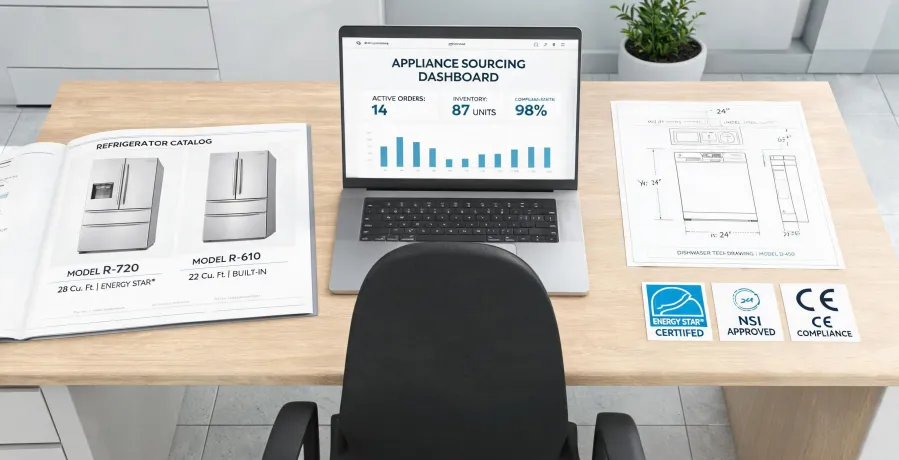
It was 7:30 on a Tuesday in early March when I pulled up to Maplewood Suites. Four-story extended-stay hotel outside Columbus, parking lot half-repaved, lobby furniture still in shrink wrap. The kind of building that looks decent from the street and needs everything replaced once you're inside. My job that morning: inspect the final batch of Frigidaire appliances before they went into 38 units.
That's what I do. I'm the quality and brand compliance manager for a regional appliance supplier. I review every unit that crosses our dock before it reaches a customer—roughly 8,000 appliances a year between commercial and residential lines. I've rejected about 6% of first deliveries in 2025 so far. Not because I enjoy it. Because I've seen what happens when I don't.
The Dial on the Frigidaire Refrigerator Means Something
The client, a property manager named Dana, met me in the lobby with a color-coded chart that looked like a battle plan. At the top, in red marker: "Refrigerator settings."
Her head maintenance tech had asked her a fair question: "Why do the Frigidaire refrigerator temperature settings 1-7 seem to do nothing?"
This one comes up more than you'd think. Most Frigidaire refrigerators use that numbered dial—1 is the warmest, 7 is the coldest. But it's not a thermostat. It's a damper control, especially on older models. It regulates how much cold air moves between the freezer and the fresh food section. Most people assume "7" means "cool faster." In one sense, it does. But set it to 7 and leave it there, and you'll freeze your lettuce and run the compressor nonstop.
I learned that lesson myself, actually, when I bought my first house. Cranked the dial to max on move-in day because the fridge was warm. Two days later, the vegetables were mush and the milk was slush. My wife still brings it up, four years later.
I found a fridge in unit 114 set to 7 with a milk carton frozen halfway out of the jug. Not ideal. The maintenance crew thought they were helping by maxing it out before turnover. Nobody had shown them the dial. The manual was in a filing cabinet nobody opened.
"Start at 4," I told Dana. "Wait 24 hours. Adjust in small steps." She wrote it down. That's the education part of my job, and I'm convinced it's the most valuable thing I do all week. An informed customer asks better questions and makes faster decisions.
A Cart Full of Knobs That Didn't Fit
As we walked through the units, I kept a checklist on my phone. Each kitchen got a Frigidaire range, microwave, refrigerator, and dishwasher. The ranges were fine. But two of the cooktops had knobs that were visibly wrong—too tall, sitting awkwardly on the valve stems.
These were Frigidaire cooktop knobs, genuine OEM replacements, from a batch I'd personally signed off on at the warehouse two weeks earlier. Look, that one's on me. The spec I approved listed the correct part number, but I didn't verify the shaft fit on the actual range. The knobs were made for an older model with a different stem height.
The contractor just stared at the cart. He didn't say anything—that was worse. A crew of four standing around, half the building's ranges installed, and knobs that didn't fit. I knew what he was thinking. I've been that guy. It's a bad place to be.
(Note to self: I finally bought a shaft gauge after this. It lives in my jacket pocket now.)
So there we were: a cart of brand-new knobs that didn't sit flush, a schedule slipping, a client who'd paid for a known brand because she trusted it. That mistake cost us $1,400 in expedite fees and lost labor. The old batch sits in a bin in my office to this day.
The most frustrating part of this work: the same issue recurring despite clear documentation. You'd think written specs would prevent misunderstandings. But interpretation varies wildly. That's why I now require a physical mockup on any replacement part order above a certain volume. It feels old-fashioned. It works.
In my first year at this job, I made the same kind of error—assumed "standard" meant the same thing to every vendor. Cost me a $600 redo and a lecture I still remember. Some lessons take twice to stick, I guess.
The Washer Lifespan Question and the kWh Math
Dana had a bigger question waiting in the laundry room. She pointed at the Frigidaire commercial top-loaders we'd quoted for the building. "How long are these supposed to last?"
I gave her the only honest answer I can give. A residential washing machine in a single-family home typically lasts 8 to 12 years. In a commercial setting—hotel, apartment building, shared laundry room—with rotating occupants who don't read care labels? Cut that in half. Five to seven years, if you're lucky. I had to say that out loud, and Dana didn't like it. Neither did I.
She pressed her lips together and looked at the machines. "The owner approved the budget based on ten years."
I get that. I really do. Part of me wants to tell clients their investment will run forever. Another part knows that setting honest expectations up front prevents a much harder conversation in year four. I compromised by showing her what we could do: commercial-grade units, heavier bearings, simpler controls. Not cheap. But cheaper than replacing residential units halfway through the building's timeline.
Here's the math I gave her: a single-family washer is rated for roughly 5,000 to 8,000 cycles over its lifetime. A 40-unit building with a shared laundry room will run through that in half the time. So we spec'd for the building, not for a family.
Then she asked about energy. "How many kWh does a fridge use?"
I pulled up the EnergyGuide label—the FTC requires those on covered appliances, so it's public data. For a typical 20-cubic-foot Frigidaire top-freezer, the estimate lands around 350 to 400 kWh per year. The actual number depends on model and usage. Set the dial wrong, let the door seals go soft, and you'll climb past 500.
At Ohio's average rate, around $0.17/kWh, that's $60 to $85 per unit per year. Across 38 units, roughly $2,500 a year just for the refrigerators. So yes, that little dial matters. It's not about cold milk. It's about operational cost over the life of the building.
Somewhere between the laundry room and the last unit, we found a Shark Fusion hair dryer sitting on top of a washer. Not ours, not Dana's. A guest probably left it, or a contractor's crew member. It looked out of place next to the commercial machines—compact, shiny, consumer-grade. I've got mixed feelings about that model line, honestly. I've handled three warranty disputes involving them in the last year, all cracked nozzles. But it's not our product. Not our problem. The mystery dryer stayed there, waiting for someone to claim it.
What I Took Home From That Walkthrough
The new knobs arrived that afternoon—correct ones this time. I checked them against the range in unit 101, shaft gauge and all. They clicked into place, flush and level. Dana looked relieved. The schedule was back on track.
And I caught myself doing the thing I always do at the end of a site visit: checking the fridge dial (set to 4), testing the freezer door seal, turning a cooktop knob one more time, just to feel it. Not a bad feeling. There's a reason I do this job. The moments where everything lines up—specs, parts, people, timing—are rare enough to appreciate.
That morning reinforced one thing I teach every new hire: the brand isn't the appliance. The brand is what happens when a maintenance tech has a question, a part doesn't fit, or a guest leaves a mystery hair dryer on the washer. Frigidaire makes solid, workable equipment for commercial projects. But the experience your client remembers is how you handle the gaps—the dials nobody explained, the knobs that didn't match, the honest answer about lifespan and energy.
So if you're managing a building and somebody hands you a spec sheet, read it like a detective. Ask what the dial numbers mean. Ask what replacement parts cost and how long they'll take to arrive. Ask for the energy label before you sign, not after. Informed customers ask better questions—and they get better buildings because of it.
Being the person who checks the details is rarely glamorous. Somebody has to do it. And if you're the one doing it, your clients feel the difference.

Greta Lindholm
Greta Lindholm is a household refrigeration analyst covering French-door, side-by-side, top- and bottom-mount refrigerators, mini fridges, beverage coolers, chest freezers, and upright freezers. She applies IEC 62552 and IEC 60335-2-24 while comparing energy consumption, usable volume, pull-down time, compartment temperature stability, freezing capacity, noise, door-seal leakage, refrigerant charge, and ambient-temperature performance. Her guides help importers, distributors, private-label teams, and appliance engineers select platforms around climate class, storage mix, efficiency labels, cabinet dimensions, service access, shipping density, and warranty exposure.