I Standardized on Frigidaire for Commercial Purchasing. Here's Why—and Where I Pause.
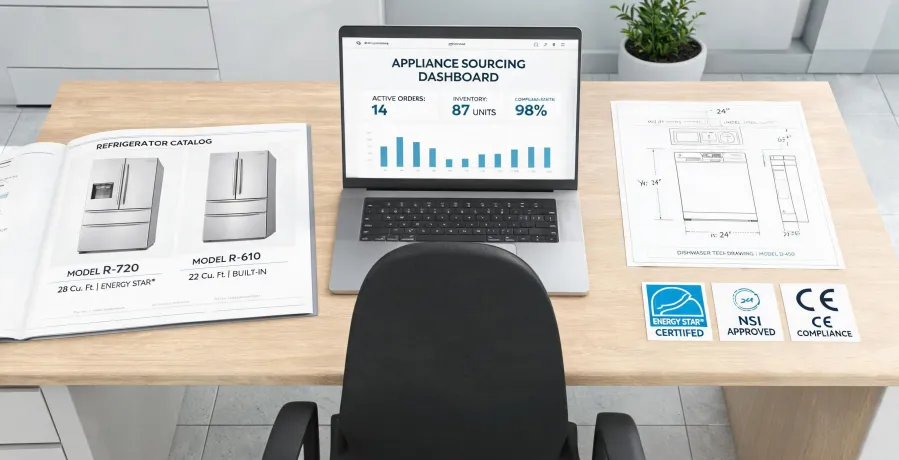
Eight months into my current job, a tenant's freezer died during a July heat wave. It wasn't a dramatic failure—no water damage, no fire—but it taught me more about B2B appliance buying than any spec sheet. The unit was still under warranty. The problem: the authorized repair shop couldn't get a compressor for three weeks. I learned that, on the procurement side, efficiency is competitive. It's less about choosing the cheapest SKU and more about choosing a brand that keeps downtime short.
I'm the office administrator for a property management company with 400+ units across three locations. I handle appliance purchasing—roughly $180,000 a year across eight vendors—and I report to both operations and finance. I don't have a favorite brand. I have a system.
My view? For most commercial appliance purchases, Frigidaire is the safer call than the more feature-heavy competitors—because the long-term cost of waiting for a part is higher than the upfront price of a unit. That sounds unglamorous. It is.
Start with the Part, Not the Appliance
When I took over purchasing in 2020, I evaluated appliances the way most non-mechanical buyers do: by the shiny features and the score on a review site. Then the freezer incident in July 2021 reset my checklist. Now I check parts availability, service network, and typical repair turnaround before I choose a brand. The checklist is simple: parts availability, service network, repair turnaround. In that order.
Frigidaire wins here because its common models use shared platforms. Many compressors, evaporator fans, and control boards are used across multiple models. That doesn't mean nothing ever breaks. It means a maintenance tech can often fix a problem with a part already stocked at a local distributor, not a special order from a warehouse. In a building with hundreds of refrigerators, that difference shows up in work-order completion time.
Frigidaire vs LG: What the Comparison Misses
I understand why people search for “frigidaire vs lg refrigerator.” LG's smart diagnostics are genuinely useful. Door-in-door storage is nice. But the question I ask is different: Which refrigerator gets back online on a Thursday before a holiday weekend?
In 2023, I weighed LG units for a 12-unit renovation. The upside was better tech and better energy numbers. The risk was service lead time if a compressor failed. I kept asking myself: is the feature upgrade worth potentially longer downtime? The expected value said Frigidaire because the downside felt too costly. A month of construction delays would eat any energy savings. To be fair, service networks vary by city. If you have a certified LG technician nearby, your math may be different. But for the three buildings I manage, Frigidaire's parts pipeline is more predictable. That's not a knock on LG. It's a logistics fact.
The Boring Stuff: Water Filters and Dehumidifiers
Most product comparisons never mention the operational details. For example, Frigidaire's three stage water filter isn't the cheapest replacement cartridge, but the compatibility list is stable. In a building with 80 refrigerators, that matters. I can stock two part numbers instead of six. The cartridges are also tested against NSF/ANSI 42, so I can answer tenant questions with a standard rather than a sales pitch.
Same with the humid Houston summers we manage. When a bedroom closet starts to smell musty or the hallway feels sticky, the fix is usually an indoor dehumidifier. My standard order is the Frigidaire 22 pint dehumidifier. Not because it's the biggest. Actually, it's not the quietest either. But because 22 pints is genuinely useful for a standard apartment, and the rating is based on AHAM DH-1 test conditions: 65°F and 60% relative humidity. That gives me a consistent expectation across units. If I buy a random brand that inflates its rating, I lose that predictability.
Why “Why Is Smoke Alarm Randomly Going Off?” Is My Least Favorite Question
The question I hear most often from tenants is: “Why is smoke alarm randomly going off at 3 a.m.?” The answer, more often than not, has nothing to do with fire. It's humidity, dust, steam, or an aging sensor. According to the National Fire Protection Association, nuisance alarms are a leading reason people disable smoke alarms. That's dangerous.
If a tenant keeps reporting false alarms, I don't start by replacing the whole alarm. I check the room's moisture level first. If the air feels humid, I'll put a Frigidaire 22 pint dehumidifier in the unit. It doesn't fix every nuisance alarm. But it fixes the most common cause in my portfolio, and it's a much cheaper intervention than an emergency electrician.
The Objections I'd Expect
Some sharp buyer will say, “You're just buying the safe brand instead of the best brand.” I'll accept half of that. Frigidaire isn't the most innovative appliance line. If you're doing a luxury spec kitchen, buy what fits the design. But in commercial property management, an appliance's job is to not become a ticket in my maintenance software. A product that breaks a little more often but gets fixed in two days is more efficient than one that lasts longer but leaves a unit empty for three weeks.
Where I still pause: when I'm buying for a common area like a laundry room or a large gym, a 22-pint indoor dehumidifier isn't enough. I'll order a larger unit instead. And if your local service infrastructure supports another brand, your calculation may be different. My point isn't that Frigidaire is the world's best. My point is that procurement efficiency comes from predictable service.
Looking back, I should have added a parts-delivery SLA into every vendor contract back in 2021. At the time, I thought specs were enough. They weren't. A contract that forces a response time would make the brand choice less critical. That's the real lesson. But until that's standard in our agreements, I'm specifying brands that make the system work.
Efficiency Is the Product
So here's my bottom line: The best appliance for commercial use isn't the one with the most stars. It's the one that arrives on schedule, works with minimal fuss, and can be repaired without a safari through the warranty department. That's why Frigidaire stays in my standard lineup. Not because it's glamorous. Because when I'm processing 60–80 orders a year, every unplanned delay has a cost. And that cost eventually ends up on a tenant's rent statement or a VP's P&L.

Greta Lindholm
Greta Lindholm is a household refrigeration analyst covering French-door, side-by-side, top- and bottom-mount refrigerators, mini fridges, beverage coolers, chest freezers, and upright freezers. She applies IEC 62552 and IEC 60335-2-24 while comparing energy consumption, usable volume, pull-down time, compartment temperature stability, freezing capacity, noise, door-seal leakage, refrigerant charge, and ambient-temperature performance. Her guides help importers, distributors, private-label teams, and appliance engineers select platforms around climate class, storage mix, efficiency labels, cabinet dimensions, service access, shipping density, and warranty exposure.