Frigidaire Repair vs. Replacement: A Total Cost of Ownership Guide for Commercial Buyers
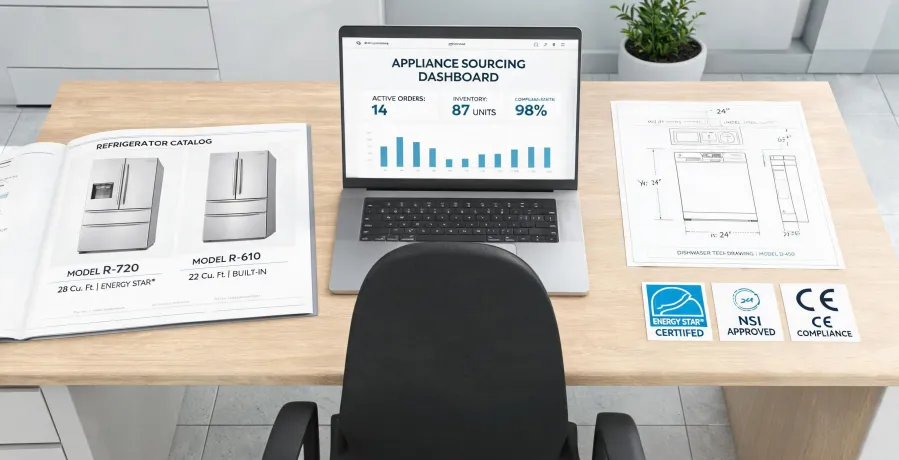
Repair or Replace? The Comparison I Run Before Approving Any Order
I'm a quality/compliance manager at a commercial appliance distributor that carries Frigidaire. I review every spec sheet, repair order, and warranty claim before it reaches our customers—roughly 200+ unique items a year. In our Q1 2024 quality audit, I rejected 6% of first deliveries because the part spec or finish didn't match the work order. That number isn't fun to explain to a hotel owner whose laundry room is down.
When I first started in this role, I assumed the lowest upfront quote was the right choice. Three budget overruns later, I stopped comparing unit prices and started comparing total cost of ownership (TCO). TCO includes the part, the labor, the downtime, the risk of a second failure, and the cost of switching ecosystems.
So here's the comparison for commercial buyers who've already decided on Frigidaire:
- Path A: Repair the existing unit with OEM parts.
- Path B: Replace it with a new Frigidaire unit.
I'll compare them across four dimensions: upfront invoice, downtime, long-term reliability, and ecosystem costs.
The First Invoice Tells You Less Than You Think
As of January 2025, a typical Frigidaire ice maker switch runs $90 to $110 before labor, and a service visit adds $100 to $150. That's often less than half the cost of a new refrigerator. On paper, repair wins. Verify current pricing with your Frigidaire parts distributor because rates change.
But I've seen the paper lie. A $500 quote turned into $800 after shipping, setup, and revision fees more than once. The $650 all-inclusive quote would have been cheaper from day one. A 'cheap' repair using a non-OEM switch can fail within six months, and then you're paying labor a second time. A new unit includes a warranty and predictable installation.
Conclusion: Repair wins on the first invoice, but the margin shrinks when you include the probability of a return visit.
Downtime Is the Hidden Line Item
Here's the thing: downtime isn't a footnote on the invoice—it's the line item that breaks budgets. A Frigidaire dishwasher top rack replacement is a routine fix if the rack is broken. But if that dishwasher is the only one in a commercial kitchen, a multi-day wait for the part plus an install visit costs more than the rack itself. I'm not guessing. I've watched a four-day repair cost a property more in catering labor than a new dishwasher would have.
New units have their own timeline, but scheduled delivery and installation can be planned around off-hours. That certainty has value. In Q3 2024, I specified a replacement over a repair for a 50,000-unit annual contract because the repair required two separate visits and the replacement solved the root cause.
Conclusion: For revenue-critical equipment, replacement usually beats repair on total cost because downtime is a real cost.
Reliability Is About Remaining Life, Not the Failed Part
A replacement part fixes a symptom. It doesn't replace the compressor, the seals, or the control board that might be next. The old unit has wear everywhere, not just in the failed switch or rack.
I only believed this after ignoring it once. They warned me about spec-matching a commercial refrigerator in 2022. I didn't listen. I approved a repair on a 12-year-old unit, and the compressor failed a month later. The customer paid for two service calls and still bought a new unit. That mistake cost us a $22,000 account renewal.
When I implemented our verification protocol in 2022, we started capturing failure rates by model and part type. That data changed how I advise clients. With a new Frigidaire unit, you get a fresh lifespan and a manufacturer warranty. It's not 100% trouble-free—no professional appliance is—but the risk is spread across the warranty period instead of landing on your P&L in one week.
Conclusion: New wins for primary equipment with heavy use; repair makes sense for low-cycle or secondary units.
Ecosystem and Specialty Costs Change the Math
This is the dimension buyers forget. Replacing an appliance can push you into a new ecosystem with its own costs.
Example: if you're considering a connected kitchen, you might ask what is the Samsung Smart Hub. It's the software platform on Samsung smart TVs and monitors that puts streaming, device controls, and settings in one interface. In a commercial setting, appliance control usually runs through Samsung's SmartThings app, not the TV hub. That distinction matters because it changes the training and integration cost. It's not a reason to replace a working Frigidaire unit.
On the specialty side, I've seen buyers apply the same 'cheapest quote' logic to a motorhome water filter UV RO high capacity system. That doesn't work. UV intensity, RO membrane rejection rate, and flow capacity vary by model. A high-capacity system costs more upfront, but its replacement filters last longer and the water quality is consistent. A low-capacity option can fail a water test, which is a lot more expensive than the filter.
And then there's the other end of the spectrum. A Beautiful by Drew Barrymore toaster is a $50 appliance. When it breaks, you don't source a replacement heating element and schedule a service visit. You replace the toaster. In that case, TCO is simple: repair is never worth it.
Conclusion: Let the part price relative to labor and ecosystem costs decide. For commodity items, replace; for systems with long service life, repair or upgrade based on spec.
Which Path Should You Choose?
If the appliance is old, heavily used, and fails in a way that threatens business continuity, replace it with a new Frigidaire unit. The TCO is better even when the invoice is higher.
If the appliance is relatively new, if the failed part is genuine Frigidaire OEM, and if the repair can be completed in one visit, repair is the right call.
If you're comparing unrelated products, don't use 'repair vs replace' as a blanket rule. A motorhome water filter UV RO high capacity system is a spec decision. A Beautiful by Drew Barrymore toaster is a replacement decision. A Samsung Smart Hub is a compatibility decision, not a TCO shortcut.
My rule after four years of reviewing commercial appliance orders: calculate TCO before you compare quotes. The cheapest path on paper is rarely the cheapest path in practice. I do not make that mistake anymore.

Greta Lindholm
Greta Lindholm is a household refrigeration analyst covering French-door, side-by-side, top- and bottom-mount refrigerators, mini fridges, beverage coolers, chest freezers, and upright freezers. She applies IEC 62552 and IEC 60335-2-24 while comparing energy consumption, usable volume, pull-down time, compartment temperature stability, freezing capacity, noise, door-seal leakage, refrigerant charge, and ambient-temperature performance. Her guides help importers, distributors, private-label teams, and appliance engineers select platforms around climate class, storage mix, efficiency labels, cabinet dimensions, service access, shipping density, and warranty exposure.