Prevention Beats Repair: What 5 Years of Commercial Appliance Purchasing Taught Me
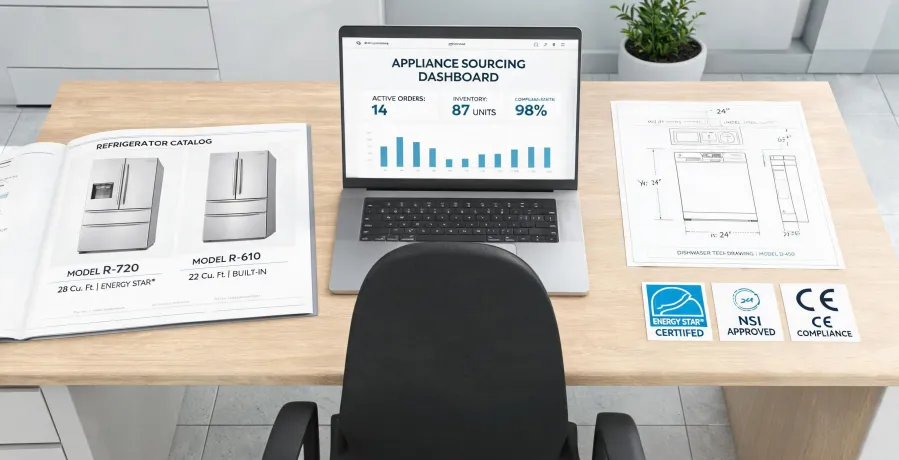
If you think preventive maintenance is an optional line item, you're already paying for a repair you haven't had yet. I'm the office administrator for a 400-person company. I manage the facilities purchasing — roughly $1.2 million a year, 12 vendors, across three locations. I report to operations and finance, which means I see both the initial purchase orders and the emergency repair invoices. After five years in this role, I've stopped buying equipment that looks impressive and started buying equipment that won't make me look bad in month eight.
People ask me about Frigidaire Gallery vs Professional all the time. They assume I'll say Professional is always better and Gallery is a waste. That's not quite right. Gallery is a residential line, and it's fine for a home where four people use the oven and the refrigerator door gets opened twenty times a day. Professional is designed for more cycles, heavier loads, and easier service access. In a building where 400 people share a kitchen and the dishwasher runs four times a day, you're not reselling the appliance; you're living with it for ten years. That's when the difference shows up.
When I took over purchasing in 2020, the shared kitchen had three appliances that had each been repaired twice. That's when I started comparing life-cycle costs instead of sticker prices. During our 2024 vendor consolidation project, I switched the shared kitchens to Frigidaire Professional. The hinges, gaskets, and counters are easier to replace, and the local distributor had parts in stock. An appliance with a nicer finish that needs a three-week wait for a hinge is a false economy. That's not an opinion; that's the difference between a $25 part and a $250 emergency service call.
But I can only speak to commercial usage. If you're outfitting a home kitchen, Gallery might be the smarter choice. The point isn't which nameplate is 'better.' The point is to think about what the machine will be asked to do before you sign.
Small parts are giant insurance policies
Take stove protectors. We bought a five-burner gas range for the main office kitchen, and nobody ordered Frigidaire 5 burner gas stove protectors. We didn't think about grease dripping onto the burners because the range looked like it could handle anything. A year later, the porcelain was stained, the drip trays were a mess, and one burner had a lazy orange flame. The protector liners cost about $35. The service call to clean and adjust the burner was $220. I've done this math more times than I want to admit.
The same mindset applies to appliances that don't seem dangerous. I once read a Whirlpool heat pump dryer review that was glowing: quiet, energy-efficient, gentle on clothes. ENERGY STAR says heat pump dryers use roughly 60% less energy than conventional models (Source: energystar.gov, accessed January 2025). But the review didn't mention that our utility room had no drain and nowhere convenient for the condensate tank. We had two hours to submit the order before a grant deadline. No time for the usual spec check. I almost approved it right then. Then I remembered the water heater leak and made myself read the installation section of the manual. It took four minutes, and it saved us from buying a dryer we couldn't install.
That's not a criticism of Whirlpool. The dryer was probably fine. It just wasn't fine for our room. And that's the whole argument for prevention: a small, boring check upfront keeps you from a large, dramatic failure later.
The failures you can't see until they're expensive
The water heater leak I keep mentioning happened in 2023. The building's hot water comes from a Mr. Water Heater unit. The manufacturer recommends an annual anode rod inspection. We skipped it for three years because nobody put it on the maintenance calendar. Then the tank corroded, a pinhole leak opened up, and a drywall ceiling in the mailroom collapsed. The total repair bill was about $8,000, plus a week of boxes getting soaked every time the roof leaked. The anode rod and labor would have cost $150. I use that comparison in every budget meeting now.
Carbon monoxide is the same category of risk, just with a higher ceiling. I had to learn where to mount a carbon monoxide detector the hard way after we found ours mounted near the floor, behind a door, too close to the gas stove. The general guidance, and NFPA code mostly aligns, is to place CO alarms at head height, at least 10 to 20 feet from fuel-burning appliances, and away from windows and supply vents. The exact distances depend on the building code in your area. But the principle doesn't change: an incorrectly placed detector is not a detector; it's decoration. Ten minutes of reading the manufacturer instructions beats the alternative.
All of these were preventable. None of them were prevented, because we didn't build the checks into our routine.
No, you don't have time to inspect everything — just the expensive things
I get the objection. 'I'm not a building inspector, and I'm already buried.' I'm not suggesting you examine every outlet and filter. But you can identify the items that fail expensively in your space. For us, that's the water heater, the gas range, the shared laundry equipment, and anything that affects air quality. I built a 12-point checklist after the 2023 water heater incident. It takes about 20 minutes per quarter. It has already caught two developing problems, and probably a few more that would have become expensive by summer.
Another objection is that prevention means buying expensive stuff. It doesn't. It means buying appropriate stuff. Sometimes the commercial line is overkill. Sometimes the $35 stove protector does the job. Sometimes the cheapest option at a given quality level is fine. The only mistake is skipping the question entirely. I've made that mistake more than once, and every time, the repair bill was bigger than the prevention would have been.
This worked because we're a mid-sized B2B office with predictable hours and moderate appliance use. A restaurant or a hotel that runs equipment hard all day has different thresholds and probably needs a real maintenance contract. I can't speak to every facility. I can only speak to this one: five emergency repairs in 2024, totaling roughly $22,000, and every one of them had an early warning we missed. Now we don't miss them.
So if you're the person approving the purchase orders, start with the boring stuff. Buy the stove protectors. Check the water heater schedule. Find out where your CO alarms are actually mounted. That's not philosophy; it's the place where the money goes. Staying ahead of it is the only way to keep it from turning into a problem you can't ignore.

Greta Lindholm
Greta Lindholm is a household refrigeration analyst covering French-door, side-by-side, top- and bottom-mount refrigerators, mini fridges, beverage coolers, chest freezers, and upright freezers. She applies IEC 62552 and IEC 60335-2-24 while comparing energy consumption, usable volume, pull-down time, compartment temperature stability, freezing capacity, noise, door-seal leakage, refrigerant charge, and ambient-temperature performance. Her guides help importers, distributors, private-label teams, and appliance engineers select platforms around climate class, storage mix, efficiency labels, cabinet dimensions, service access, shipping density, and warranty exposure.