I Wasted $28,000 on Frigidaire Appliance Orders. Here's What I Learned
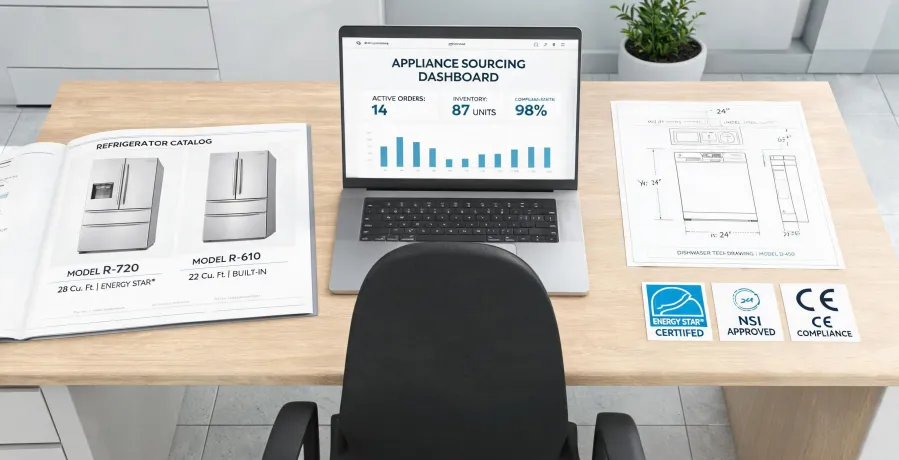
I've been handling appliance orders for commercial properties for seven years. In that time, I've personally made 23 significant mistakes, totaling roughly $28,000 in wasted budget. Maybe $27,500, I'd have to add up the chargebacks again. Many of those mistakes involved Frigidaire products, because Frigidaire is the brand most of my clients ask for. I'm sharing this so you don't repeat the expensive parts.
The pattern is always the same: the order looks right on paper. The product is right, the price is right, and then something invisible makes the whole installation wrong. I used to blame bad luck or lazy vendors. The truth was my own assumptions. The fix wasn't a better supplier. It was a better checklist.
The Surface Problem: It Looks Like a Simple Purchase
The most common search I do is "frigidaire freezer light bulb replacement." That's a fair place to start. A freezer light burns out, a kitchen manager wants it fixed, and the replacement looks like a household item. It should be simple.
It wasn't simple for me the first time. I ordered a bulb that fit the socket. I didn't check the refrigerator's service manual for maximum wattage in an enclosed fixture. The bulb turned on. After three weeks, the heat cracked the lens. An $8 bulb ended up costing $286 in technician visits and a replacement lens.
People assume that if a part is physically compatible, it's correct. What they don't see is how much of an appliance depends on specs that look insignificant: wattage, base type, temperature rating, moisture resistance, and the OEM part number. "Compatible" is a marketing word, not an engineering guarantee. Honestly, I've never fully understood why "universal" replacement bulbs exist if they aren't universal. If anyone in the lighting industry can explain the logic, I'd love to hear it.
The Deeper Problem: Specs Aren't Optional
The same issue damaged a much larger order. We chose a Frigidaire refrigerator counter depth bottom freezer for a small condominium kitchenette. The product page said "counter depth." The room looked like it would fit. We placed the order and arranged delivery. It didn't fit. The problem wasn't depth. It was width plus hinge clearance plus door trim. The actual opening was 29.75 inches. The refrigerator's installed width was 30.25 inches. That's half an inch. Half an inch of overconfidence cost $850.
What most people don't realize is that "counter depth" isn't a single standardized number across all models. It's a design intent. The actual dimensions live in the datasheet, not the product title. Per FTC guidelines (ftc.gov), claims like "counter depth" have to be truthful and not misleading, and I'm not saying Frigidaire's claim is wrong. But "counter depth" still doesn't tell you whether the door will clear a trim piece. The datasheet does.
Honestly, I'm not sure why the industry keeps describing complex products with two-word labels. My best guess is that product pages are built for browsing, not installation. That's why the ordering process has to include installation data.
The Cost of Ignoring the "Small" Stuff
By the time the wrong replacement bulb and the counter-depth bottom freezer mistakes happened, the real damage was not just the money. It was the schedule. A commercial kitchen or a guest room without a working fridge has a ripple effect. The manager is on the phone. The resident is leaving a review. The contractor is billing by the hour. The part you need isn't in stock, and expedited freight costs more than the part.
We once needed a Frigidaire freezer light bulb replacement on a Friday afternoon. The bulb was $9. The fastest freight option was $48. The technician's minimum trip charge was $145. A $9 part, a $48 ride, a $145 labor add-on, and thirty minutes of everyone's time. That's what "just the bulb" really costs.
The Real Villain: The One-Off Items Nobody Specs
Here's something I learned later: the biggest losses are rarely the expensive appliances. They're the last-line items on the order—the small things someone adds because they're cheap and useful.
A Presto sandwich maker is a perfect example. It's a low-cost countertop appliance that works fine on its own. We added one to a common-area kitchen order without thinking. It also drew more current than the circuit could handle when combined with a refrigerator and two coffee machines. The breaker tripped during an event. The sandwich maker didn't fail; the plan failed. From the outside, it looked like an electrical problem. The root cause was a missing load calculation on a $38 item.
The same thing happens with heating. A building manager once asked the very reasonable question: "How long can a space heater run continuously?" The honest answer is: it depends on the model, the cord, the outlet, the circuit, and the manufacturer's manual. There isn't one number that applies to all space heaters. We found a heater that had been running in a common area for days. It still worked, but the outlet was discolored and the case was hot. We replaced it with a commercial unit and installed a dedicated circuit. In hindsight, the heater wasn't the problem; the absence of a spec was.
The Fix That Cost Almost Nothing
I do not trust product pages when an installation is on the line. I trust dimension drawings and OEM part numbers. The checklist I use now is simple enough to put on a sticky note.
- Get the exact model number and read the manual before ordering any part.
- Verify the installation dimensions, not the marketing dimensions.
- Calculate the electrical load for all things on the same circuit.
- Apply the same spec check to a $38 small appliance as to a $2,000 refrigerator.
- Use OEM part diagrams, including the Frigidaire store's parts lookup, instead of "compatible" listings.
Each checklist item adds about four minutes to the order. In the past 18 months, we've caught 47 potential errors before they became site visits. That has saved thousands of dollars and a lot of embarrassment. This is the part I want to underline: checklists are not bureaucracy. They are speed. Switching from reactive ordering to this pre-check cut our turnaround from five days to two.
Oh, and I should add one more thing: the checklist doesn't end after the order is placed. We photograph the shipping label and the unit's serial number. You don't think you need that until a shipment arrives with a damaged box. Then a serial number is worth more than the original order.
I do not expect to get to zero mistakes. I still occasionally miss something. But the cost of a mistake now is much lower because we catch it before it becomes an installation emergency. The counter-depth bottom freezer and the freezer light bulb taught me the same lesson in different ways: appliances are systems, not products. Treat them like systems, and the process becomes boring. Boring, in this job, is the best outcome.

Greta Lindholm
Greta Lindholm is a household refrigeration analyst covering French-door, side-by-side, top- and bottom-mount refrigerators, mini fridges, beverage coolers, chest freezers, and upright freezers. She applies IEC 62552 and IEC 60335-2-24 while comparing energy consumption, usable volume, pull-down time, compartment temperature stability, freezing capacity, noise, door-seal leakage, refrigerant charge, and ambient-temperature performance. Her guides help importers, distributors, private-label teams, and appliance engineers select platforms around climate class, storage mix, efficiency labels, cabinet dimensions, service access, shipping density, and warranty exposure.