What I've Learned Buying Frigidaire for an Office: Burner Replacement, Dishwasher Models, and the Requests In Between
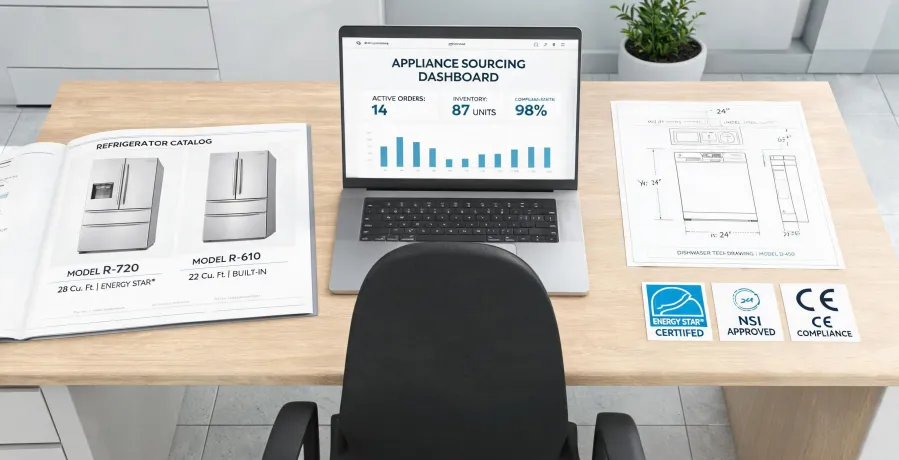
Before you buy any appliance or part for your office, get the full model number. That's it. That's the first thing I write down when a request lands on my desk, whether it's a Frigidaire stove burner replacement or a Nuka Cola mini fridge for a themed breakroom. A model number is insurance against the exact mistake that wasted three days of my life in 2022.
I'm the office administrator for a ~200-person company, and I manage purchasing across three locations. Since 2020, I've processed roughly 60-80 orders a year with eight or more vendors on rotation. I report to both operations and finance, which means I feel every return-shipping charge in the department budget. (Ugh.)
Why model numbers are non-negotiable
The conventional wisdom is that buying a replacement part is easy: find something that looks like the old part and click. I learned the hard way that it isn't. In 2022, our breakroom range needed a burner. I looked at the stove, decided it was obviously a standard Frigidaire element, and ordered from an online parts seller. The moment it arrived, it didn't connect. The terminal connectors were wrong, and the wattage was higher than the range was designed to handle. I returned it, paid shipping, and waited three days for the right one.
Since then, I've stopped guessing. Here is the process I use for any Frigidaire stove burner replacement: get the model number from the range itself, not from memory or an old invoice; open the parts diagram for that exact model; search authorized distributors with the part number, not a generic description; and compare return policies before comparing prices.
Genuine burner elements for Frigidaire ranges generally run from about $35 to $90 as of January 2025, based on authorized parts distributor quotes. That price range isn't the point. The point is that a $22 marketplace listing with 'fits most models' in the title is a bet, not a purchase. (Note to self: never trust 'fits most models' again.)
What I've learned about Frigidaire dishwasher models
Frigidaire dishwasher models are another place where the model number saves you. They look similar from the front, but the similarities end there. Most are 24 inches wide, but the cutout depth, water inlet location, and rack configuration can differ. In 2024, when we replaced the dishwasher in our main breakroom, I measured the opening and located the old unit's model tag before looking at any new options. I do not trust the 'same brand' shortcut. Brand is not a specification.
The old dishwasher was a Frigidaire Gallery model, and the current model I considered had a slightly different depth spec. It would have stuck out past the cabinet face and looked terrible. (Thankfully, I checked the spec sheet before ordering.) That's the kind of detail that doesn't show up in a review. For an office, I focus on a model with a stainless tub, a removable filter, and quiet operation, because our kitchen sits next to a workspace. Those are preferences, not universal must-haves.
If your office only runs the dishwasher twice a day, a mid-range residential model will likely be fine. If you're serving food continuously, you need a commercial-grade machine that meets NSF certification. A residential dishwasher is not built for 20 loads a day, and that's okay — it's just not the right tool for that job.
What about the requests that aren't Frigidaire?
Not every purchase request is a Frigidaire. In 2024, I was asked to source a Nuka Cola mini fridge for the gaming corner. My first thought was that it was a toy. Then I checked the specs: most of those mini fridges are thermoelectric, not compressor-based, and they cool only about 15-20 degrees below room temperature. A 4-liter version might hold a few sodas, but it won't keep a can ice-cold in a warm room. (Which, honestly, is a disappointment.)
That same week, an employee sent me a question about the Innza IPL hair removal device price. I don't buy beauty devices often, so I didn't rely on memory. I compared three retailers, found prices spread by about $40, and noticed that one seller's 'limited-time' price was the regular price at another store. I sent the employee a short comparison and skipped the urgency marketing. The skill was the same as buying a burner: verify the exact product, verify the model, and verify the return policy.
Then there was the email subject line: Can electric toothbrush remove tartar? I am not a dentist, so I don't answer that from my own authority. According to the American Dental Association, once plaque hardens into tartar, brushing won't remove it; a dental professional has to do that. I forwarded the source to the employee and moved on. Knowing when I'm not the right person to answer is also part of the job.
Where I draw the line
Let me be honest about limits. For an office breakroom with normal daily use, Frigidaire's residential lineup has held up well in our buildings. Parts are reasonably easy to find, and service support has been sufficient for our volume. But if you're a restaurant, a hotel, or any operation that runs equipment for hours every day, don't treat this article as a recommendation for a commercial line. That's not a brand problem; it's a category boundary.
This advice worked for our setup because our usage is predictable. If you're buying for rental properties, or for a kitchen that runs two loads an hour, your criteria will be different. You may want fewer features, different certification, or different service contracts. That's exactly why the right habit is to start with the model number and the actual demand, not with a 'best of' list.
So next time someone asks you to buy an appliance, ask for the model number first. If they don't know it, you've already found the real problem.

Greta Lindholm
Greta Lindholm is a household refrigeration analyst covering French-door, side-by-side, top- and bottom-mount refrigerators, mini fridges, beverage coolers, chest freezers, and upright freezers. She applies IEC 62552 and IEC 60335-2-24 while comparing energy consumption, usable volume, pull-down time, compartment temperature stability, freezing capacity, noise, door-seal leakage, refrigerant charge, and ambient-temperature performance. Her guides help importers, distributors, private-label teams, and appliance engineers select platforms around climate class, storage mix, efficiency labels, cabinet dimensions, service access, shipping density, and warranty exposure.