Why Our Office Appliance Purchases Kept Failing (And the Pre-Buy Checklist That Finally Ended the Cycle)
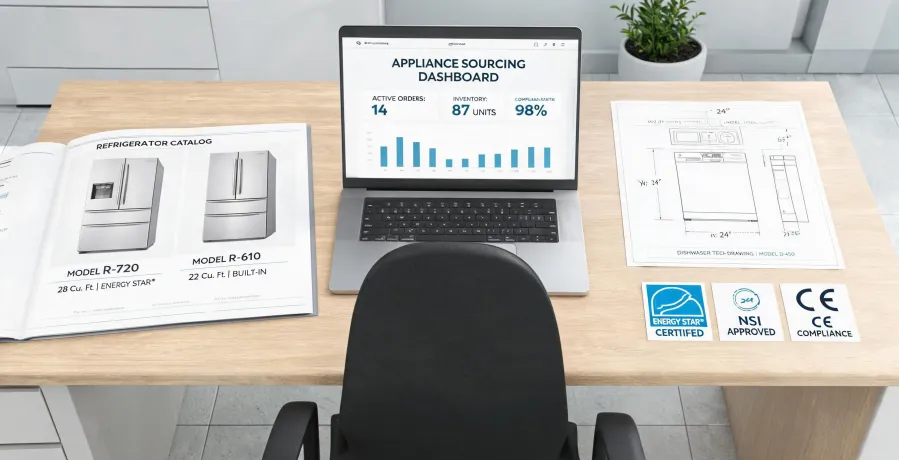
In March 2023, I approved a $2,180 order for six Panasonic fridges for our satellite offices. Four of them started throwing temperature alarms within eleven months. The vendor's "commercial-grade" label turned out to mean "commercial-priced." Our maintenance log picked up six new residents.
That order wasn't the first time. It was the fourth. Which means I should have known better. (I didn't.)
The Problem I Thought We Had
For the first two years I blamed the equipment. Cheap models. Bad luck with brands. Maybe someone on the overnight cleaning crew kept unplugging things to charge their phone.
I bought a Panasonic Genius microwave in early 2021 because the inverter tech sounded superior to the cheap on/off magnetron units we'd been cycling through. Six months later, the door interlock failed on a unit that cost us $740. Different brand, same story. New model, new ticket.
Then it happened with non-appliance hardware. We installed EVVA smart locks across two floors, and suddenly half the team couldn't badge in on Monday mornings. Then I replaced our failing floor cleaners with handheld vacuums — twice — because the team kept saying the suction was weak. Each replacement was a hundred-plus dollar decision made in fifteen minutes.
I kept fixing symptoms. Which is exactly what everyone in my seat does, because the symptoms are the only things that generate tickets.
What Was Actually Happening
The problem wasn't brands. It was that I was buying appliances against a feature list instead of against a use case.
Mistake 1: I trusted the category label, not the spec sheet
Here's something vendors won't tell you: "commercial" in appliance marketing is usually a marketing tier, not a durability standard. The same chassis gets a different badge and a $300 markup. When I finally pulled the service manuals for the Panasonic fridge line, the actual difference between our "commercial" model and the consumer model was the door handle and the warranty card.
The one time the label did match the internals was the Panasonic inverter compressor — you can hear the difference. The fridge hums at variable speed instead of kicking on and off. No compressor cycling, no cold-spot swings, fewer repair calls. But I only learned that because I asked the service tech, not because the sales sheet said so.
Mistake 2: I let reviews decide purchases I should have checked against our own floor
I bought two Xiaomi E10 robot vacuums off the back of a review that ranked them well for hard floors. Our offices are 60% low-pile carpet. The E10 does fine on hard floors. On our carpet, the brush rollers wrapped themselves in carpet fibers within a month and needed dissection with a screwdriver. A 40-second check of our own floor survey would have caught this. I didn't have a floor survey. I had a review.
What most people don't realize is that robot vacuum reviews are usually written on the reviewer's floor, in the reviewer's home, at the reviewer's dust level. None of that transfers to a commercial corridor with foot traffic from forty people.
Mistake 3: I bought the spec I could compare, not the spec that mattered
The handheld vacuum situation burned me twice for the same reason. I compared suction ratings in kPa and picked the higher number. What I should have compared was runtime under load and how long it takes to empty the bin — because a handheld vacuum that dies mid-sweep on the second floor is worse than one with 15% less suction that keeps running for twenty minutes.
The spec sheet sells the spec that looks good on paper. The spec that saves your maintenance budget usually doesn't fit on a single line.
The EVVA smart lock episode was the same mistake in a different costume. "AES-256 encryption" and "app-based access" read great. Nowhere in the marketing was "how does this behave when the WiFi drops for ninety seconds during a firmware update" — which is exactly what locked out half the team that Monday morning. The lock was fine. The failure state was undocumented.
Mistake 4: I kept buying replacement instead of buying the answer
Why does this keep happening? Because replacement purchases feel fast and responsible. "The unit failed, so I replaced the unit." Simple. Done. Nobody questions it.
But replacement hides the real cost. Every failed appliance isn't just the sticker price — it's the labor to install it, the downtime, the staff who had to work around it, and the credibility you burn with the people who use the equipment. I never counted those. I only counted purchase orders.
What the Mistakes Actually Cost
When I finally sat down and pulled every appliance-related ticket from 2019 through 2024, the numbers were uglier than I'd expected.
- The failed Panasonic fridge order: $2,180 up front, $890 in emergency service calls, five weeks of juggled storage, and one very patient office manager who stopped trusting my recommendations.
- The Genius microwave door interlock: $740 + $220 service = nearly a thousand dollars on a unit that was supposed to last five years. It didn't reach two.
- Two rounds of handheld vacuums ($310 total) that both got returned. The second pair was a rush order, so I paid $60 in shipping I didn't have to.
- The Xiaomi E10 units needed replacement brush rollers twice before we gave up and moved them to hard-floor areas only.
- The EVVA lock fiasco cost us around $480 in reissued badges and emergency IT time, plus the Monday morning where the facilities team looked like they'd forgotten how doors work.
Rough total: somewhere between $6,000 and $7,000 in avoidable spend over four years. I've kept the actual ledger, because that's the only way I've been able to stop myself from doing it again.
Dodged a bullet in early 2024 when I almost signed off on six more fridges on the same spec — same vendor, same "commercial-grade" language. I caught it because I'd finally made a checklist. That near-miss is the reason the checklist exists.
The Checklist That Ended the Cycle
Here's what we now run on every appliance purchase above $200 — before the PO, not after the return window closes.
- Confirm the failure state, not the feature list. Ask the vendor: "What happens when [the critical dependency] fails?" If they can't answer in writing, that's the answer.
- Match the spec to our actual environment. Floor type, ambient temperature, foot traffic, power stability. If we don't have a floor/environment survey, we build one before the order.
- Pull the service manual, not the brochure. The maintenance interval and the part that fails first are usually documented. It's just not the part the sales sheet wants you to read.
- Total cost of ownership, not sticker price. Add install, downtime, staff disruption, and expected replacement interval. If the math is close, buy the unit that fails less, not the one that costs less.
- Identify the actual operator, not the approver. The person emptying the vacuum bin needs to be able to do it in under two minutes. If they can't, the spec is wrong.
- Write the failure log first. Before purchase, write down what failure would look like and what it would trigger. If that sentence is uncomfortable, don't order yet.
- Keep the receipt for the reason, not the review. Time-stamped reason we bought it ("carpet floors, 40 staff, 6 fridges") beats a saved review link every time something goes wrong.
The short version: buy against the environment, not the brochure. Compare total cost, not sticker. Write down how it fails before you pay for it.
An informed buyer asks better questions and skips the return window. I'd rather spend twenty minutes on that checklist than another quarter explaining to the office manager why the fridge is beeping again. (Trust me on that one.)

Greta Lindholm
Greta Lindholm is a household refrigeration analyst covering French-door, side-by-side, top- and bottom-mount refrigerators, mini fridges, beverage coolers, chest freezers, and upright freezers. She applies IEC 62552 and IEC 60335-2-24 while comparing energy consumption, usable volume, pull-down time, compartment temperature stability, freezing capacity, noise, door-seal leakage, refrigerant charge, and ambient-temperature performance. Her guides help importers, distributors, private-label teams, and appliance engineers select platforms around climate class, storage mix, efficiency labels, cabinet dimensions, service access, shipping density, and warranty exposure.