Frigidaire vs. Mixed-Brand Commercial Specs: A Quality Inspector's TCO Comparison
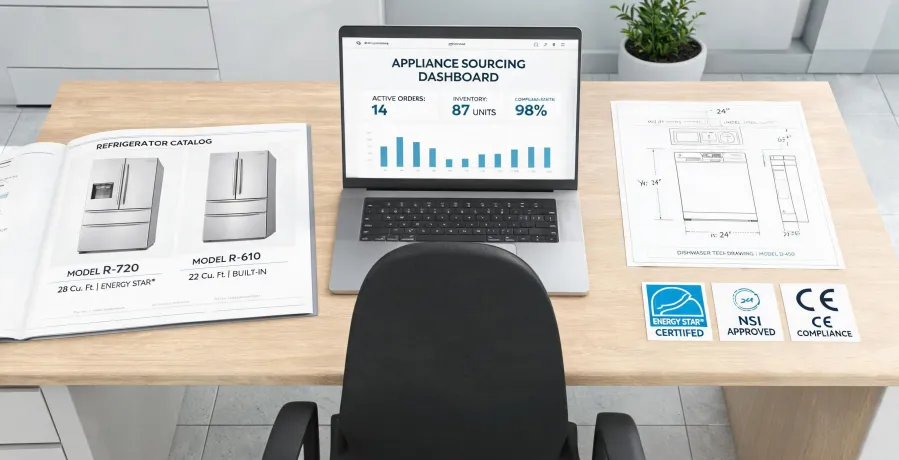
I'm the quality assurance manager at a commercial appliance distribution company. I review every unit before it ships to hotels, apartment complexes, and office buildings—roughly 1,400 appliances a year. Maybe 1,350, I'd have to check the system. In 2024, I rejected about six percent of first deliveries. The reasons were all over the place: scratched panels, control boards that didn't pass calibration, and one batch of ovens where the cooling fan kept running long after the cycle ended.
That last issue—the Frigidaire oven fan won't turn off complaint—shows up in our service records more than you'd expect. It's usually a stuck limit switch or a control board fault. The fix is a part that costs between $40 and $80 (typical 2025 pricing, verify current rates), and any licensed appliance tech can handle it. But it taught me something about how to evaluate brands in a commercial setting.
Now, there's a question contractors and facility managers wrestle with constantly: should you spec an all-Frigidaire commercial suite, or should you go with a mixed-brand package?
This isn't a brand loyalty pitch. I've recommended mixed-brand setups—including Mitsubishi mini split units for buildings that need ductless HVAC. What I've also seen is the "we'll save more this way" logic fail, because the upfront quote doesn't tell you what the equipment actually costs over its working life.
What I'm Comparing, and Why
I compare these two approaches on four dimensions:
- Total cost of ownership (TCO), not just the sticker price
- Parts and service network strength
- Energy efficiency and operating costs
- Spec compliance and practical usability
Each dimension has changed a decision I've been part of, so I'll give you the honest conclusion at the end.
Dimension 1: Total Cost of Ownership
Let's say you're outfitting a 120-unit apartment building. The all-Frigidaire package covers refrigerators, ranges, microwaves, dishwashers, and washers and dryers. The mixed-brand approach swaps in a different refrigerator line for a few dollars less per unit and uses a Mitsubishi mini split system for the HVAC instead of a traditional package unit.
On paper, the mixed quote comes in 10–15% lower. That's meaningful on an order that size. But TCO tells a different story.
The Mitsubishi mini split is a genuinely strong product. I won't argue with its efficiency credentials—they're real. But it requires certified installers. That's a specialized contractor, not your regular appliance installer. Every installation needs a manufacturer-certified technician to sign off. And when it needs service, you're paying that same specialized rate and working around their schedule.
The Frigidaire side, from my seat, is simpler. Parts are everywhere. Any licensed appliance tech can open a Frigidaire unit without proprietary training. When the oven fan issue shows during warranty, the fix is a phone call and a part swap, not a waiting game.
The Frigidaire freezer H1 code is a good example. Clients panic when that error shows up. Based on what we've logged in inspection and repair reports, H1 points to a sensor problem more often than not. The part costs $25–60, and replacing it takes a qualified tech about an hour. The panic costs more than the repair. But the repair only stays cheap when the service network can get the part to you quickly. I've seen a $60 sensor turn into a $4,000 damage claim because a property manager couldn't find a qualified tech before the freezer contents thawed.
My rule of thumb after four years of reviewing equipment: the lowest upfront quote is rarely the lowest total cost. I calculate TCO—unit price, installation, service calls, downtime, and replacement frequency—before comparing any two vendors seriously.
Dimension 2: Parts & Service Network
This dimension ends up deciding most of the contracts I've been part of.
Frigidaire's distribution network is mature. Replacement parts typically arrive at our warehouse within one to three business days. That consistency is exactly what a quality inspector looks for. When a hotel freezer goes down, a three-day part wait is already painful. A two-week wait is a crisis.
Mitsubishi mini splits have a different service reality. The equipment is well-built, but "certified installer required" changes the math. If your property relies on mini splits, you need a maintenance vendor with that specific training. That's an extra annual agreement, and it belongs in the TCO spread.
We watched this play out during a 220-room hotel renovation. Actually, it was early 2024—Q1. The engineering consultant recommended Mitsubishi mini split units for a handful of suites that had no ductwork. The rest of the building used standard PTAC units. The maintenance team ended up training on two different systems, and the mini split vendor required its own pre-startup inspection before the units went live. None of it was wrong—it just added a layer of coordination that the all-Frigidaire sections of the project never needed.
The takeaway: a second brand isn't just a product addition. It's a second supply chain.
Dimension 3: Energy Efficiency & Operating Costs
I'm not an HVAC engineer, so I can't speak to precise SEER ratings or refrigerant line-set specs. What I can tell you from a QA perspective is that operating cost depends heavily on whether the unit performs to spec in real conditions.
Take a question I get from hotel F&B managers all the time: how long can spaghetti last in the fridge? The answer, according to the USDA Food Safety and Inspection Service (fsis.usda.gov), is three to five days at 40°F or below. But that guidance assumes the refrigerator actually holds 40°F. We've tested units that drift five to seven degrees during normal cycling. That drift shortens food shelf life and increases energy consumption because the compressor runs harder than it should.
In our inspection data, Frigidaire commercial refrigerators and freezers hold temperature within spec more consistently than the alternatives we've tested. ENERGY STAR certification sets the baseline for efficiency (Source: energystar.gov), but in my opinion, consistency is what actually drives operating cost. A unit that cycles properly uses less energy and keeps food safer.
On the HVAC side: if you're weighing mini splits against resistance heat or window units, the mini split is probably more efficient. That's a fair reason to spec one. But if you're comparing a mini split system to a well-maintained ducted package unit, the gap narrows. Building layout and control strategy matter more than the nameplate.
Dimension 4: Spec Compliance & Practical Usability
This is the one most cost models miss, and it's the one I lose sleep over.
Here's an example that had a real impact. A hotel group we work with spec'd a shallow pocket waffle maker for their breakfast bar. The sales rep, trying to be helpful, upgraded the order to a deep-pocket model. On paper, a waffle maker is a waffle maker. In practice, they're not even close.
Shallow pocket waffles cook faster and come out crispier. The deep-pocket model added about 45 seconds per batch. During a three-hour breakfast service at a 150-room hotel, 45 seconds per waffle backs up the whole line. We caught the substitution during inspection, rejected the delivery, and got the correct units before the property's opening.
That's spec compliance. And here's a detail worth noting: the waffle maker wasn't a Frigidaire product at all—it was a line item in the hotel's kitchen equipment package. But the lesson holds across every brand in a building: what you specify is what you should receive. Standardizing on fewer brands makes that rule easier to enforce. Every brand addition means another spec sheet to check, another service channel to manage, and another failure mode to plan for.
Frigidaire's commercial lineup spans refrigerators, freezers, ovens, ranges, microwaves, dishwashers, washers, dryers, ice makers, dehumidifiers, and water filters. When the kitchen and laundry rooms come from one catalog, the inspection workflow is predictable.
So Which Should You Choose?
Here's the honest version.
Go all-Frigidaire when:
- You're outfitting a large property where downtime creates immediate revenue loss
- You want a single procurement channel and a straightforward service network
- Your maintenance team doesn't hold specialized certifications for niche equipment
Go mixed-brand (including a Mitsubishi mini split unit) when:
- The building design physically requires ductless HVAC
- A mini split is the only practical climate solution for certain spaces
- You have the operational capacity to manage multiple vendors and inspection requirements
In my experience, the all-Frigidaire route wins more often than not for large commercial properties. But I've also approved mixed setups when the building demanded it. Part of me wants to say 'standardize on one brand and never look back.' Another part knows that the right HVAC solution sometimes requires a manufacturer with specific expertise. We went back and forth on a 120-unit apartment project—the numbers said going mixed would save about twelve percent on the HVAC portion, and my gut said standardize everything. We compromised: Mitsubishi for the ductless zones, Frigidaire for every kitchen and laundry appliance. It was the right call for that building.
I can only speak to my context, though. Our situation involved a large property with a centralized maintenance staff. If you're dealing with a smaller building, a different layout, or an in-house team already certified on mini split service, the calculus might shift. This worked for us because those conditions were true for us.
There's something satisfying about a property where every appliance behaves exactly as specified. After all the inspection hours, the vendor arguments, and the spec sheets, seeing a full building open without a single service complaint is the payoff. That's what quality assurance is for. It just starts before the units ship—with TCO thinking and a clear specification, not the lowest number on a quote.

Greta Lindholm
Greta Lindholm is a household refrigeration analyst covering French-door, side-by-side, top- and bottom-mount refrigerators, mini fridges, beverage coolers, chest freezers, and upright freezers. She applies IEC 62552 and IEC 60335-2-24 while comparing energy consumption, usable volume, pull-down time, compartment temperature stability, freezing capacity, noise, door-seal leakage, refrigerant charge, and ambient-temperature performance. Her guides help importers, distributors, private-label teams, and appliance engineers select platforms around climate class, storage mix, efficiency labels, cabinet dimensions, service access, shipping density, and warranty exposure.